If you’ve spent any time researching thatch fire safety, you’ve probably noticed the same handful of terms come up again and again: fire retardant spray, fire blankets, water drenching systems. What’s less obvious – and what most guides skip over – is that these aren’t three versions of the same thing. They fall into two genuinely different categories of protection, and understanding the difference is the key to choosing the right combination for your property rather than just picking whichever one a contractor mentions first.
This guide breaks down the distinction between passive and active fire protection for thatch roofs, what each option actually does, and how to think about which combination suits a private home versus a commercial lodge or estate.
Passive Protection: Chemical Fire Retardant Treatments
Chemical fire retardant sprays are the most common starting point for thatch fire protection, and for good reason – they treat the thatch material itself. A professionally applied treatment penetrates the reed and, when exposed to heat, forms an insulating char layer that limits the oxygen available to a fire and slows the rate at which flame can spread across the roof surface.
This is what makes it passive protection: the treatment doesn’t detect or react to a fire in progress. It simply changes how the thatch itself behaves when exposed to flame or heat, buying critical time for a fire to be spotted and dealt with before it takes hold.
Reapplication is not a one-off event – it’s an ongoing part of maintaining certification.
Fire retardant treatment process
We use Thatch Marshal 8000 Fire Retardant, which is applied both externally and internally with a double application under the overhang. This meets the requirements of section 8, standard ASTM E108/section 8.2.3 of SANS 10407:2006.
Most insurance companies require fire protection to be in place for thatch roofs to process claims in the event of fire damage. Our service ensures compliance with these requirements, offering peace of mind and enhanced safety for your thatch roof. The coating prevents flaming, allowing the grass or reed to smoulder only rather than catching alight and spreading. The smouldering area can then be extinguished with dry foam extinguishers.
Thatch Marshal 8000 has a unique water-based formulation that reduces the spread of a flame. It also enhances the appearance of your thatch roof and helps prevent aging of the materials. It also prevents damage from birds and may even help to reduce your current insurance premium.
Treatment can only be applied to thatch roofs that are in good condition, either because they have been well maintained or have recently been re-thatched. Before any treatment is carried out, the roof must be assessed by a competent thatcher to determine its suitability.
If the assessment indicates that the roof requires maintenance or re-thatching, these repairs should be completed before the treatment is applied. This ensures the best possible performance and longevity of the treatment.
Where a property has an internal ceiling fitted directly against the roof trusses, no internal treatment is required. However, if the property has an open-volume ceiling or no ceiling at all, the exposed internal roof spaces must also be treated with a double coat.
The treatment should be reapplied every five years. A 5-year Guarantee Certificate is issued from the date of completion, provided the roof met the required condition at the time of treatment.
In cases where treatment is applied to an older roof that has not been fully maintained, and the client is unable to carry out the recommended repairs due to budget constraints, a limited guarantee of 1 to 2 years may be offered, depending on the roof’s condition.
If the roof shows signs of rot, mould, or significant deterioration, it is strongly recommended that it undergoes a thorough overhaul or be re-thatched, depending on the extent of the damage, before any treatment is considered.
Passive Protection: Fire Retardant Blankets
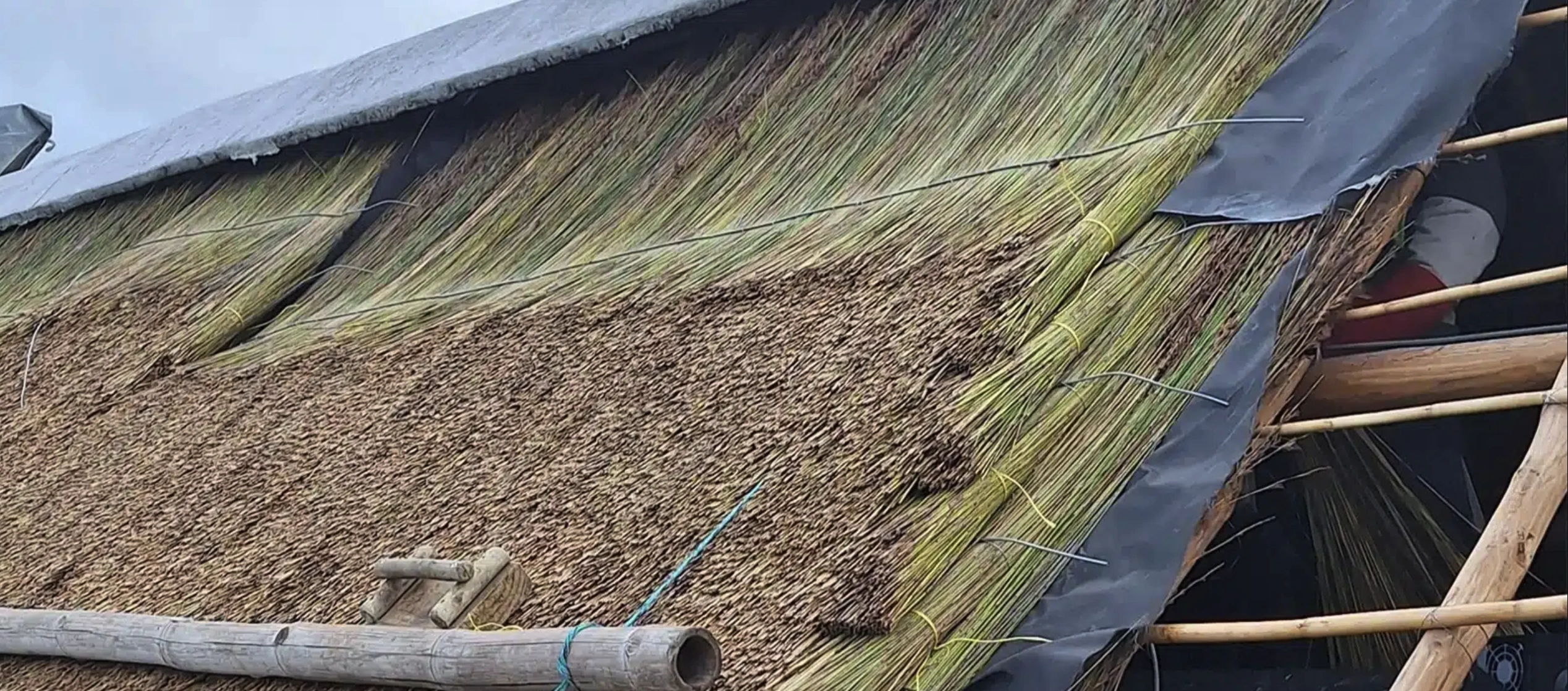
Fire retardant blankets take a different approach to the same passive category. Rather than treating the reed chemically, a fire-resistant barrier layer is installed between courses of thatch during construction or a full rethatch. This barrier is designed to slow the spread of fire through the roof structure, giving occupants more time to react.
Because blankets are built into the roof structure rather than sprayed onto the surface, they typically can’t be added to an existing roof without disturbing the thatch – they’re most relevant during a new build, full rethatch, or major overhaul.
If, during a roof assessment, it is found that the roof does not have a fire blanket installed, the appropriate recommendation will depend on the roof’s overall condition, thatch thickness, and structural integrity. Where the existing roof is in sound condition and has sufficient structural stability, an additional layer of thatch reed may be installed over the existing roof, incorporating a fire blanket as part of the new thatching layer. Alternatively, if the roof has reached the end of its serviceable life or is structurally compromised, a complete rethatch may be required. In some cases, insurers may accept the application of a fire-retardant treatment as an alternative to installing a fire blanket, as this can provide a more cost-effective solution. However, acceptance of this option will depend on the individual insurer’s underwriting requirements and policy conditions.
Active Protection: Water Drenching Systems
Water drenching systems represent the active category – rather than changing how the thatch behaves in a fire, these systems respond to a fire event directly. Sprayers positioned around the roof capping activate to drench the thatch surface, working to suppress flame and slow fire spread while emergency response is organised.
This is generally positioned as additional protection layered on top of passive treatment, rather than a replacement for it – particularly for larger or higher-value properties such as lodges and estates, where the roof area and exposure risk are greater.
Our semi-drencher roof protection system is designed to provide rapid suppression of external roof fires and to reduce the risk of ignition from airborne embers and radiant heat.
The system operates using a dedicated booster pump that is hydraulically designed to deliver the required flow rate and pressure across the entire roof surface. The pipework is sized through hydraulic calculations to ensure that sufficient water volume and pressure are available at each discharge nozzle, providing uniform water distribution over the roof.
When the system is activated by opening the manual ball valve, the booster pump immediately supplies water to the pipe network. Water is discharged through strategically positioned spray nozzles installed along the roof ridge, creating a continuous sheet of water that wets the thatch surface. This suppresses surface ignition, cools the roof covering, and assists in preventing the spread of fire.
The system design considers pipe sizing, flow rate, operating pressure, nozzle discharge, and total water demand to ensure effective roof coverage for the required duration. Each installation is engineered to suit the specific roof size and configuration, ensuring optimum performance in accordance with the applicable fire protection design criteria.
Heat and smoke detectors can be installed to provide early warning of a potential fire, helping to alert the occupants of the property as well as neighbouring properties. For enhanced protection, the detection system can be integrated with the home’s security alarm system and connected to a 24-hour monitoring service.
If smoke or excessive heat is detected, the system will immediately trigger an alarm signal to the monitoring centre. The monitoring service will contact the property owner or designated contact to verify whether the alarm is a false activation or a genuine emergency. If a fire is confirmed or there is no response, the monitoring centre can promptly notify the local fire department and emergency response services.
Early detection and rapid notification significantly reduce emergency response times, increasing the likelihood of containing the fire before it spreads. This can help protect lives, minimise property damage, and reduce the overall financial impact of a fire incident.
So Which One Does Your Roof Actually Need?
In practice, most properly protected thatch properties use more than one layer rather than relying on a single method. A sensible way to think about it:
• Chemical treatment is the baseline most insurers and municipalities expect as a minimum for any thatched property.
• Fire blankets add a further structural layer of passive protection, and are worth discussing at the point of a new build or full rethatch rather than retrofitting later.
• Water drenching systems add active, responsive protection on top of the above, and become increasingly worth considering as roof size, occupancy, and property value increase.
The honest answer is that the right combination depends on your specific property, its size, its location, and what your insurer or local municipality requires. In today’s time it would be recommended to have multi layers of protection be it residential, commercial or private. A proper on-site assessment is the only way to get a definitive answer for your roof.
Can 13mm galvanise chicken mesh help with fire prevention?
Yes, chicken mesh (hexagonal wire mesh) can contribute to the fire performance of a thatched roof, but it should not be regarded as a fire prevention measure on its own.
Its effectiveness depends on how it is installed and what it is intended to achieve.
How chicken mesh can help
✓ Holds the thatch in place: During a fire, the mesh can help prevent burning thatch from breaking away and spreading fire to other parts of the property or neighbouring buildings.
✓ Reduces fire spread: By retaining the thatch, it may slow the collapse of the roof covering and help limit the spread of burning material.
✓ Provides reinforcement: It helps secure the thatch against wind damage and animal disturbance, which also contributes to the roof’s overall durability.
What chicken mesh does not do
✗ It does not prevent the thatch from igniting.
✗ It does not act as a fire barrier or insulation like a fire blanket.
✗ It does not replace a semi-drencher system, fire-retardant treatment, or other fire protection measures.
Best practice
For optimum fire protection, chicken mesh should be considered an additional protective measure rather than a primary fire protection system. A comprehensive fire protection strategy for a thatched roof should include:
✓ A fire blanket installed beneath the thatch.
✓ A semi-drencher water system.
✓ A professionally applied fire-retardant treatment.
✓ Heat and smoke detection linked to a monitored alarm system.
✓ Lightning protection.
✓ Proper chimney construction with a spark arrestor.
✓ Regular roof inspections and maintenance.
Chicken mesh can provide a secondary level of fire protection by retaining the thatch during a fire, reducing the likelihood of burning material becoming detached and spreading the fire. While it may assist in limiting fire propagation and maintaining the integrity of the roof covering, it is not a substitute for recognised fire protection measures such as fire blankets, fire-retardant treatments, or semi-drencher systems. It should be considered as part of an integrated fire protection strategy for thatched roofs.
Frequently Asked Questions (FAQs)
Can I use just one type of fire protection, or do I need all three?
Chemical treatment is generally the minimum expected for any thatched property. Blankets and water drenching systems are additional layers, and whether they’re necessary depends on your property type, size, and risk profile. If additional peace of mind is required in the event of a fire, we recommend installing both the semi-drencher system and applying the fire-retardant treatment to provide an enhanced level of protection.
Does adding a water drenching system mean I don’t need chemical treatment?
No – a water drenching system is designed to work alongside passive protection, not replace it. Chemical treatment protects the thatch material itself continuously, while a drenching system responds actively if a fire starts. The semi-drencher system is installed independently of the fire-retardant treatment. Once the fire-retardant chemical has been applied, it cures within a few hours to 24 hours, depending on environmental conditions. The drencher pipework is then installed along the ridge of the roof, above the thatch. When the drencher system is activated, the water discharged onto the roof does not damage, remove, or reduce the effectiveness of the cured fire-retardant treatment.
How do I know if my existing roof can have a fire blanket added?
The fire blanket must be installed with 100% coverage beneath the thatch. All membrane joints must be sufficiently overlapped to ensure there are no gaps or exposed areas, maintaining a continuous and effective fire barrier.
Will any of these options affect the appearance of my thatch roof?
Fire-retardant treatment enhances the appearance of the roof by providing a clean, well-maintained finish, similar to a clear protective coating, while improving the thatch’s resistance to fire.
Traditional Thatch Roofs has been protecting thatch roofs across Cape Town and the Western Cape since 1986 If you’re not sure which combination of fire protection is right for your property, contact us for a professional assessment and quote.