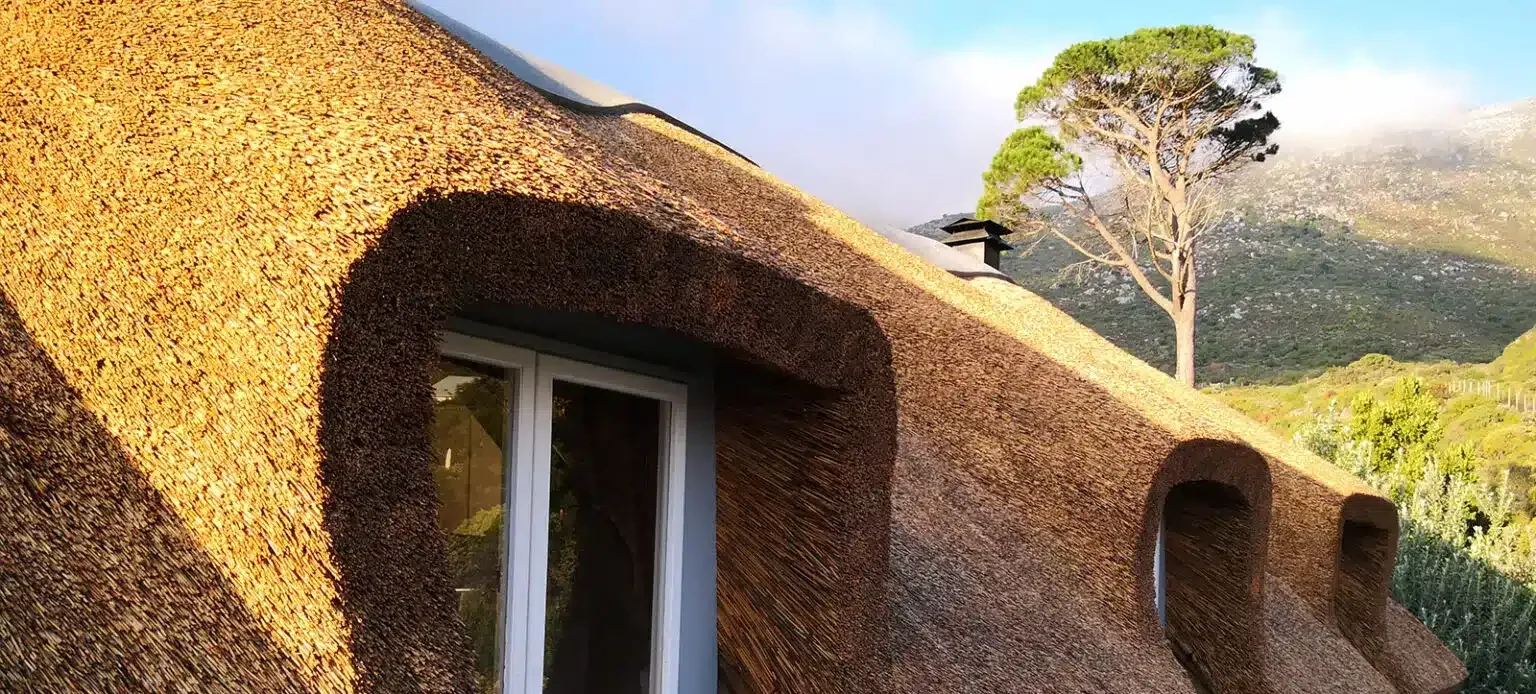
Most thatched homeowners are familiar with the big milestones – a full rethatch every 20 to 35 years, a ridge replacement every few years, an annual inspection. But there is a critical service that sits between those major interventions that many homeowners either overlook or misunderstand: re-compaction.
It is not rethatching. It is not a cosmetic brush-over. And if your roof needs it and you delay, what starts as a relatively straightforward job can become a far more expensive problem.
This guide explains exactly what re-compaction is, why Cape Dekriet roofs in the Western Cape are particularly susceptible to compaction loss, how to tell if your roof needs it, and what the process actually involves.
What Re-Compaction Actually Is
When a thatch roof is first installed, the reed is packed tightly into the roof structure at a precise density – typically between 35 and 50 kilograms per square metre for a properly laid Cape Dekriet roof. This density is what gives the roof its water-shedding performance, its insulation properties, and its structural resistance to wind.
Over time, this density breaks down. The thatch dries out, individual reeds shrink slightly, the binding material stretches, and gravity does its quiet, relentless work. The roof loses its compaction. The surface that was once tight and uniform begins to loosen, sag in places, and create the micro-gaps that allow wind, water, and birds to do real damage.
Re-compaction is the process of restoring the roof to that original density. It does not involve replacing the thatch. Instead, the thatcher works systematically across the entire roof surface – re-tensioning the binding wire or sisal twine from the inside, using a leggett (a flat, ridged dressing tool) to drive the reed back into a tight, even plane, and reshaping the eaves and ridge line to a clean, parallel finish.
Think of it as a structural reset. The materials are still there. The job is to put them back where they belong.
Why Western Cape Roofs Lose Compaction Faster
This is something that does not get discussed enough. Cape Dekriet – the solid-stemmed reed native to the Western Cape – is one of the finest thatching materials in the world. Its dense, closed stem gives it exceptional longevity compared to hollow inland grass. But that same solid stem means Cape Dekriet contains a percentage of moisture when it is harvested and laid. It needs that moisture to remain pliable during installation.
Over the first one to two summers after a new roof is laid, the Dekriet loses that residual moisture as it cures in the heat. The stems contract. The binding material, which was tensioned against the fresh reed, is no longer under the same load. It loosens.
This is entirely normal and expected – which is why reputable thatchers in the Western Cape recommend a re-compaction service within the first two to three years of a new installation as a matter of course, not as a sign that anything went wrong.
Beyond the initial settling, ongoing compaction loss accumulates through:
Inadequate original compaction – not every thatcher applies the same standard. If a roof was laid without sufficient compaction from the start, degradation accelerates significantly.
Coastal wind load – the consistent south-easterly and north-westerly winds that batter properties in Melkbosstrand, Blouberg, Paternoster, and along the West Coast physically work individual reeds loose over time.
Bird activity – hadedas, weavers, and in some coastal areas, kelp gulls, pull loose strands from the surface. A well-compacted roof gives them very little purchase. A poorly compacted one becomes a nesting invitation.
Thermal cycling – the Western Cape’s temperature swings between cold, wet winters and hot, dry summers cause the reed to expand and contract seasonally, gradually fatiguing the binding.
Five Signs Your Roof Needs Re-Compaction
You do not need to be a thatcher to spot these. Walk around your property and look up.
A ragged or uneven bottom edge along the eaves
A well-compacted roof has a clean, crisp line at the eaves – almost like a freshly cut hedge. If the bottom edge looks irregular, with individual reeds hanging at different lengths or flaring outward, compaction has been lost in the lower courses.
Visible binding wire or sisal twine from ground level
The fastening material should be buried deep within the thatch profile, invisible from outside. If you can see horizontal lines of wire or twine running across the roof face, the thatch above it has thinned and loosened to the point where the fixings are exposed. At this stage, rainwater can track directly down the twine and into the roof structure – this is how a compaction problem becomes a leak.
Bird holes or concentrated bird activity in one area
Birds do not randomly choose where they nest in a thatch roof. They find the spots where compaction is lowest, where individual reeds have worked loose and created an entry point. Persistent bird activity in a specific area almost always indicates a compaction failure at that location.
Areas where the thatch visibly sags or ripples
Stand back and look at the roof plane. It should be flat and consistent. Depressions, ripples, or areas where the surface dips suggest the binding has loosened and the reed is no longer held firmly against the laths beneath.
The roof is between 3 and 12 years old and has never been re-compacted
For Cape Dekriet roofs in the Western Cape, the initial re-compaction window is typically two to three years post-installation. If that service was not done, or if the roof is approaching the ten-year mark without any compaction work, an assessment is overdue – regardless of whether visible symptoms are present yet.
What the Re-Compaction Process Involves
Understanding the process helps homeowners assess whether a quote they receive is for genuine re-compaction or something more superficial.
Assessment first
Before any work begins, a thorough inspection of the binding material is essential. The binding wire or sisal twine that holds the thatch to the lath framework must be in good enough condition to be re-tensioned without snapping. If the twine is degraded – which happens particularly with lower-quality jute or polypropylene twines that some contractors use – pulling it tight will simply break it. In that case, re-compaction alone is not sufficient and a more substantial intervention is needed. This is why the quality of the original fastening material matters enormously.
Re-tensioning the binding from inside
Where the binding is in good condition, the thatcher works from inside the roof void, methodically pulling each course of twine or wire tight and re-securing it. This pulls the thatch back into the lath structure and restores the vertical pressure that keeps the reed from shifting.
Surface dressing with the leggett
On the outside, the thatcher uses a leggett – a wooden or rubber paddle with a ridged face – to dress the thatch surface. The leggett is worked upward across the roof in overlapping strokes, driving protruding reed ends back into the body of the thatch and closing any gaps in the surface. It is skilled, physical work. The quality of the finish depends entirely on the experience of the thatcher doing it.
Ridge and eave finishing
The ridge and eave lines are dressed to a clean, parallel edge. The eaves are trimmed using a mechanical or hand cutter where necessary, and the ridge cap is inspected and repaired if needed. A correctly finished re-compaction leaves the roof looking close to newly laid – tight, even, and with sharp, clean lines at every edge.
The result
A properly re-compacted roof has restored density across the surface, improved water runoff performance, significantly reduced bird access, and a structural integrity that can carry the roof through another decade of Western Cape weather before the next intervention is required.
Re-Compaction vs. Overhaul vs. Rethatch: Which Does Your Roof Need?
These three services are often confused, and the distinction matters – both for your roof and your budget.
Re-compaction is appropriate when the binding material is sound, the core thatch body is intact, and the primary issue is density loss and surface loosening. The existing materials are retained and restored.
A roof overhaul goes a step further. In addition to re-compaction, it involves trimming back the degraded outer layer of thatch – typically the bottom 100mm of rotten or weathered reed – and adding fresh material at the eaves and any thin areas to restore the profile. It is the right intervention when the surface layer has deteriorated but the structural body of the roof is still fundamentally sound.
Full rethatching is necessary when the binding material has failed, the thatch body has thinned below a functional threshold, or the structural poles and laths beneath have been compromised by water ingress. This is a full strip-and-relay – the most significant and costly intervention.
The honest answer to which your roof needs is that only a thorough inspection by an experienced thatcher can make that call. But if your roof is showing the signs listed above and is under fifteen years old, re-compaction or overhaul is almost always the appropriate response.
Frequently Asked Questions
How often does a Cape Dekriet roof need re-compaction?
For a new installation, a re-compaction is typically recommended within the first two to three years as the thatch cures and the binding settles. After that, a well-maintained Cape Dekriet roof in the Western Cape should require compaction work every eight to twelve years, depending on coastal exposure and maintenance history.
Can I re-compact a thatch roof myself?
No. Re-tensioning binding wire from inside the roof void requires access to the structural lath framework and an understanding of how tension distributes across the roof. Surface dressing with a leggett requires significant skill and experience to achieve an even, watertight finish. Attempting either without training is likely to cause more damage than it resolves.
Will re-compaction stop birds from nesting in my roof?
A properly re-compacted roof provides a significantly tighter surface that gives birds very little purchase. It will not guarantee zero bird activity, but it removes the easy entry points that a loose, poorly compacted surface creates. Where bird pressure is extreme – particularly in coastal areas with large gull populations – galvanised bird netting can be applied over the surface as an additional measure.
How long does re-compaction take?
For an average residential property, a re-compaction typically takes two to four days depending on roof size, complexity, and the degree of compaction loss. A roof overhaul that includes re-compaction plus surface material replacement will take longer.
Traditional Thatch Roofs has been maintaining and restoring thatch roofs across Cape Town and the Western Cape since 1986. If your roof is showing signs of compaction loss – or if it simply hasn’t been assessed in several years – contact us for a professional inspection and quote.